
Education as anAid to Life
6 Nobel Peace Prize Nominations
Nominated in 1949, 1950, and 1951 for Education for Peace
First Female Doctor in Italy
University of Rome School of Medicine, 1896
Case dei Bambini
First classroom opened in Rome, 1907 — the Children's House
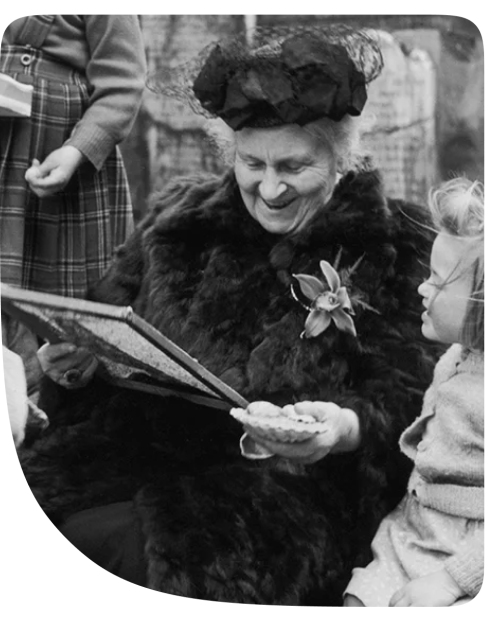

What Is Montessori Education?
Education is an aid to life. It is a natural process carried out by the human individual, and is acquired not by listening to words, but by experiences in the environment. Montessori is an educational philosophy based on the belief that a child learns best within a social environment that supports and nurtures each individual's unique development. It is not a curriculum, it is a way of seeing the child.Connecting with children has been a great joy and satisfaction, seeing them evolve from infancy to early adulthood, and being part of a team that shares a culture which is an integral part of our philosophy.Dr. Montessori observed children around the world and found that the laws of development she had recognised in Italy were universal and inherent in children of all races and cultures.She realized that children construct their own personalities as they interact with their environment and that the foundation of the whole personality is laid during the early years of life. This discovery is now universally accepted in scientific circles.
Follow the Child
The child’s natural curiosity and developmental needs guide every decision in the classroom. Adults observe and facilitate, never impose.
Scientific Pedagogy
Every material, lesson, and environment is grounded in careful observation and experimentation. Montessori referred to her approach as 'scientific pedagogy.'
Universal Child
This approach is built on two core ideas: the universal characteristics shared by all children, and the recognition of each child as a unique, unrepeatable, and respected individual.
Education for Peace
Montessori believed education plays a vital role in fostering peace, where children who develop according to their inner laws contribute to a more harmonious world.
Four Planes of Human Development
Montessori observed four distinct periods in human development, each with unique characteristics, learning modes, and developmental imperatives. She called for educational approaches specific to each plane.
Plane 1
The Absorbent Explorer
Striking physical and psychological development. The child is a concrete, sensorial explorer engaged in the work of psychological self-construction and building functional independence.
0-6 years
Plane 2
The Reasoning Mind
The child develops a powerful reasoning mind and moral sense, turning outward to the world and the culture in which they live. Imagination flourishes.
6-12 years
Plane 3
The Social Self
Adolescence, a time of social reformation and self-discovery. The young person seeks their place in society and develops their sense of identity and values.
6-12 years
Plane 4
The Mature Contributor
The young adult takes their place in the world with a developed personality, practical knowledge, and a deep sense of moral responsibility and civic engagement.
18-24 years

The Ideas That Make Montessori Work
Montessori introduced several powerful concepts to explain how young children learn. Understanding these helps parents see why the Montessori environment looks and works, the way it does.
The Absorbent Mind
Montessori described the young child's ability to effortlessly assimilate sensorial stimuli, information from the senses, language, culture, and concepts as the "absorbent mind." This remarkable power is unique to the first plane of development and begins to fade as the child approaches age six.The child does not choose what to absorb, they absorb everything. The environment we prepare matters enormously.
Sensitive Periods
Montessori observed windows of special sensitivity to particular stimuli during early childhood. The Montessori classroom responds to these periods by making appropriate materials available while they are active.
Language acquisition
Birth - 6 yrs
Interest in small objects
18mo - 3yrs
Order & routine
1 - 3 yrs
Sensory refinement
Birth - 4 yrs
Social behaviour
2.5 - 4 yrs
Normalization
Montessori observed in children aged 3–6 a psychological state she termed "normalization" arising from deep concentration and focus on activity that serves the child's developmental needs. It is characterized by spontaneous discipline, happy continuous work, and genuine care for others.When a child is truly engaged and their work is respected and uninterrupted, something remarkable emerges, a joyful, self-directed learner.
Multiple Intelligences
One key difference between Montessori and conventional schooling is the adoption of elements from Howard Gardner's Multiple Intelligence Theory. Dr. Montessori would seem to have developed her approach along very similar lines, long before Gardner codified it at Harvard.Remarkably, this educational approach also has roots in ancient Indian texts, the Upanishads connecting Montessori's insights to a timeless wisdom tradition.

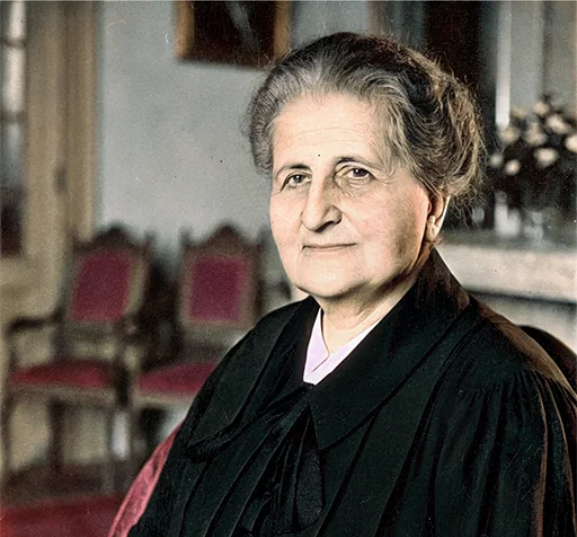
Dr. Maria Montessori(1870 - 1952)
Maria Montessori was an early 20th century Italian educator and visionary, a woman who led an extraordinary life. As the first woman to graduate from the University of Rome School of Medicine, she gained early recognition for her work in mathematics and the established sciences.She pursued a study in anthropology and psychiatry, two disciplines that would prove invaluable in her work as a physician and scientist. Her approach to education was developed through careful observation of children, combined with her background in psychology and her belief that the education of children was the means to create a better society."The potential of the child is not just mental, but is revealed only when the complete Montessori method is understood and followed."- Dr. Maria MontessoriDr. Montessori observed children around the world and found that the laws of development she had recognised in Italy were universal and inherent in children of all races and cultures. She developed a comprehensive model of psychological development from birth to age 24.As her theory and practice deepened, she came to believe that education had a role to play in the development of world peace, that children allowed to develop according to their inner laws of development would give rise to a more peaceful and enduring civilisation.
What Does a Montessori Child Look Like?
Normalization is the hallmark of a Montessori environment working as it should. When children are deeply engaged in meaningful work, when concentration is respected and uninterrupted,something beautiful happens.
“The child’s choice, practical work, care of others and the environment, and the deep concentration that comes from uninterrupted work reveal a human being who grows not only academically, but emotionally and spiritually.”
3-6
Age when normalization is first observed
∞
Lasting impact on character and ability
0
External rewards needed — motivation is intrinsic
100%
Child-led — every activity chosen freely

Beyond Academics A Complete Human Being
Many people, hearing of the high academic levels reached by Montessori children, miss the deeper point. The real value lies in something far greater than academic achievement.

Academically Strong
SMontessori children reach high academic levels, not through drilling, but through a genuine love of learning. Curiosity, not pressure, drives their achievement.

Emotionally Grounded
A child who cares deeply about others and the world. Who handles disappointment with resilience, celebrates others’ success, and approaches challenges with equanimity.

Spiritually Aware
A child who seeks their own way to contribute to the world. Who finds meaning in their work, connection in their community, and purpose in their life.
“This is the essence of real Montessori work, a child who cares deeply about others and the world, and who seeks their own unique way to contribute.”
— THE MONTESSORI PHILOSOPHY IN PRACTICE
Experience Montessori at KGM
See our prepared environment, meet our certified teachers, and understand why this method, faithfully followed since 1999, makes such a profound difference for the children in our care.